Cold Water Corals
Cold-water coral habitat distribution and risk assessment along the Bermuda–Nova Scotia subsea cable corridor.
Overview
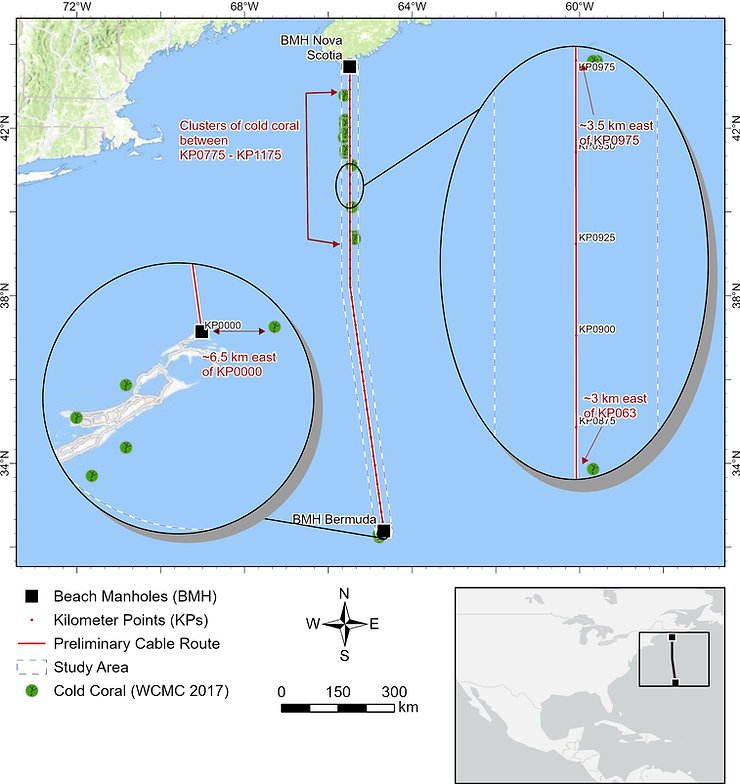
Building on the established corridor from Project 1, this analysis evaluates how cold-water coral habitats intersect with the proposed subsea cable route between St. George’s, Bermuda and Baccaro Point, Nova Scotia.
The focus is on the spatial distribution of coral clusters relative to the corridor centerline, their proximity to critical landing zones, and potential ecological sensitivities along both nearshore and offshore segments.
Results
Cold Coral Distribution Patterns
-
Bermuda Landing Zone (KP0000):
A cold-water coral feature is located approximately 6.5 km east of KP0000, near the Bermuda BMH. While not directly intersecting the corridor, its proximity makes it an area of interest during environmental permitting and construction planning. -
Nova Scotia Nearshore (KP0775–KP1175):
A high-density cluster of cold-water coral points is observed between KP0775 and KP1175. This stretch represents the most significant aggregation of cold coral features along the route, concentrated near the Nova Scotia landing zone. -
Mid-Corridor:
Several scattered cold coral occurrences are positioned between KP063 and KP0975, located approximately 3–3.5 km east of the corridor. These are outside the immediate impact zone but still relevant for corridor refinement and buffer assessment.
Ecological Sensitivity & Risk Characterization
-
Bermuda:
Low to moderate sensitivity due to distance (~6.5 km) from the cable route. No direct interaction, but early-stage awareness is recommended for environmental compliance. -
Nova Scotia:
High sensitivity zone due to dense cold coral clustering within close range of the landing corridor. This area likely requires site-specific mitigation or routing refinement to minimize impacts. -
Mid-Corridor:
Low sensitivity. Scattered points are located several kilometers away, posing minimal direct conflict with the cable alignment.
Hotspot Intensity
-
A single major hotspot is located near the Nova Scotia BMH, spanning KP0775–KP1175, indicating a corridor-adjacent ecological constraint zone.
-
A minor, isolated hotspot is present offshore Bermuda (~6.5 km east of KP0000), representing low immediate risk but moderate environmental sensitivity.
-
Mid-ocean segments show diffuse, low-intensity clusters outside the cable corridor, confirming minimal direct overlap.
Recommendations
-
Bermuda BMH: No immediate route adjustment required, but environmental baseline surveys are recommended to confirm coral locations and ensure regulatory compliance.
-
Nova Scotia Approach: Conduct detailed benthic and ecological surveys (e.g., MBES, ROV imagery) between KP0775–KP1175. Consider micro-routing or protective installation measures to reduce potential impacts to cold-water coral habitats.
-
Mid-Corridor: Maintain current alignment; no direct interactions identified.
-
Regulatory Coordination: Engage early with relevant environmental agencies and marine habitat managers to develop appropriate mitigation and permitting strategies for cold coral areas.
Conclusion
This cold-water coral assessment highlights a critical ecological sensitivity zone near Nova Scotia’s landing approach and minor ecological considerations near Bermuda.
Early integration of coral habitat data into corridor planning supports proactive risk mitigation, regulatory compliance, and sustainable engineering design. Offshore segments remain largely low-risk, reinforcing the overall feasibility of the proposed alignment with targeted nearshore adjustments.